The word ‘Scarcity of resources’ we learnt from our childhood. The world’s resources such as air, water, trees etc. are depleting due to the mankind actions. For an example 95% of the water available in the earth is non-drinkable for the mankind and only 5% is available for the usage. 95% of unused water is untouched and mankind can make them useable through interventions. Is this possible? Does this be true in the new aged world? Many authors/scholars have researched this area and proved that world has full of abundance of resources. This is possible with the new aged telecommunication and technologies that have reshaped the resources providing abundance for opportunities for the world and businesses. Therefore this let me to critically assess the followings areas in the context of SL context.
What is ‘anywhere revolution’ and what drives?
“The global network will provide unbelievable connectivity and intelligence. It might be the most exciting development in the world. It can bring nonlinear change in every economy.” Says Dov Baharav, CEO, Amdocs.
Emily outlines in her book “Anywhere” a fascinating paradox that holds great promise. Location matters less than ever before: We’re all on a network and can access whatever people, resources, and information we need to work, learn, or play. The connectivity powers the world and it connects people wherever they are and making more powerful conversations and experiences. This enables billions of people in the world to actively participate in innovations, wealth creation, social development through which world is going to have abundance opportunities and resources.
Emily further outlines that the technologies at the core of these such as common digital network, wireless data transmission, and a standard digital representation for pictures have not only changed us as people, but they have reshaped the business landscape for those activities and across those industries.
One attribute that comes out in all technologies is the ‘Connectivity’, which has transformed the world to have instant messaging, Instant video conferencing, instant movie download or picture upload etc. anywhere and at anytime. A digital connection is an element of each device’s value proposition to us: the Internet’s global collection of information resources, the cell phone’s ability to take our calls and messages while we’re on the go, and the digital camera’s ease of reuse and retransmission of our images.
So what is anywhere? “When all people, and all the things we care about, will be connected. Location where you are, where others are and things will become less important. Things you care of meeting someone, taking to someone or ordering food from a restaurant will not require an effort. The bridge between these two is the connectivity. Three elements that drive the connectivity;
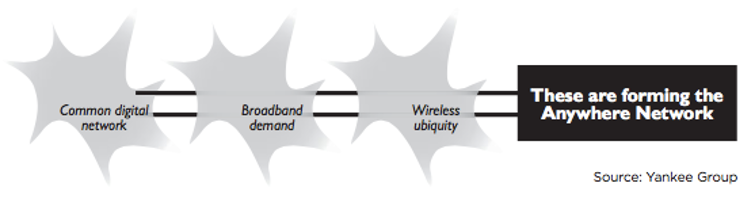
- Common Digital Network
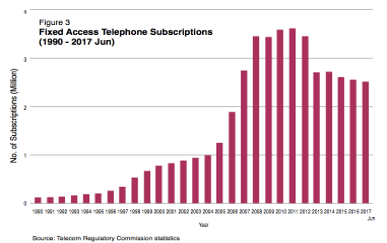
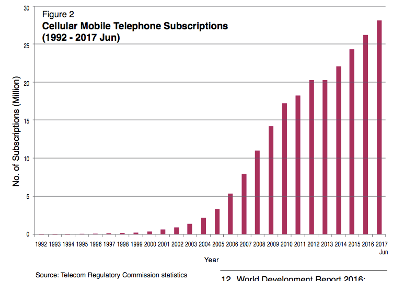
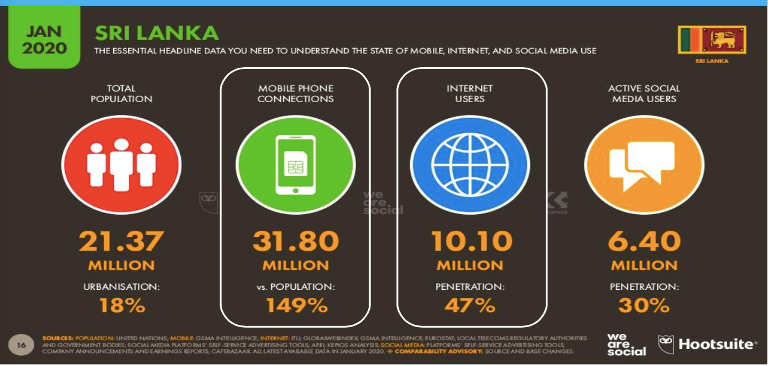
Emily defines that is capable of carrying anything that can be reduced or translated into binary bits: voice, music, and images of course, but also money and oceans of information so vast in size and variety, and growing so quickly, that they’re virtually impossible to characterize. This begun with range of independent fixed-line telephone wired connections. In SL Sri Lanka Telecom originally introduced fixed-telephone lines in 1970s and connectivity is formed through voice calls. Fixed phone subscription peaked in 2011 with over 3.5 million connections and later declined to 2.5 million subscriptions in 2017 due to the penetration of mobile communication. (Exhibit 2) Later, with emergence of 2G and 3G network the mobile telecommunication partners such as Celltel, Dialog and Mobitel further strengthened the coverage and connectivity. SL mobile phones penetration reached 150% in 2020 due to the drastic drop of cost of feature phones as well as smart phones from China. Total mobile telephone subscriptions reached over 26 million in 2017. (Exhibit 3)
Sri Lanka is ahead of the digital networks compared to other developing countries due to the infrastructure and competitiveness in the industry. Mobile devices penetrated more than 100% every mobile services provider tries to gain the share from the highly penetrated market. 4G technologies are in place now and mobile telecommunications partners are eying at getting the 5G technologies that will help tremendously to build e-commerce and connectivity.
II. Broadband Demand
This refers to the capacity of a network or bandwidth determines the data travel speed, upload and download speed. When there are more PCs, more mobile connections and other Internet devises are connected, consumption of data rises and hence it will have an impact on the data speed.
By June 2017, the TRCSL reported a total of 1 million+ fixed Internet subscriptions (both narrowband and broadband) and another 4.4 million mobile broadband subscriptions. Since some accounts are used by more than one person, it can be assumed that at last around 30% of the population (6.25 million) were regularly using the Internet in Sri Lanka in 2017. (Exhibit 4)
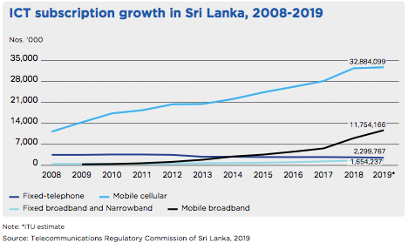
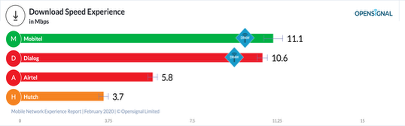
SL telecom is also the broadband service provider where most mobile communication partners share infrastructure. As shown in exhibit 4 demands for mobile broadband has risen significantly from 2017 to 11.7 million subscriptions in 2019. Even though SL has better digital connection, download speed of broadband is at 22 Mbps and upload speed is at 10 Mbps, those are low compared to South East Asia countries. This will have an impact on transmission of high definition (HD) videos and high demand on movies, pictures, online streaming. Sri Lanka meeting the UN Broadband Commission’s affordability target for 2025 – 1 GB of mobile broadband data costs approximately 0.49% of monthly income, lower than the UN’s target of 2%.
III. Wireless Ubiquity
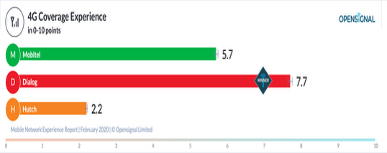
The word ‘ubiquitous’ means stable network of connection. Wireless network such as Wi-Fi network, Bluetooth, Zigbee extending the possibilities given by wired networks, to keep us connected anywhere anytime whether you’re inside your home or in a public area. In SL wireless connections are growing and depend on 4G coverage. Dialog Telecom has better 4G coverage than other 2 players in the SL. (Exhibit 6) Government has initiated free Wi-Fi zones specially in public areas but those network’s bandwidth is low and hence speed of connectivity is at the low level. Currently restaurants, hotels and businesses are provided Wi-Fi connectivity with stringent controls. SL’s smart mobile penetration is at 25% and this will be further increased with the reduction in prices of smart mobile devices where more people will connect to network using Wi-Fi and Bluetooth.
How does anywhere revolution influences the ‘abundance of resources’?
Anywhere revolution helps individuals or organisations to grow abundance of network access possibilities. Organizations and governments are able to access their own network (Intranet) or access to the world wide web of networks. This enable exchange of information, store and retrieve information. With more people accessing World Wide Web and Internet globally new network access platforms have emerged such as cloud computing and cloud storage those are excusive to set of registered base of individuals.
When it comes to SL, nearly half of the population is connected to the Internet. Usage of mobile phones and computers increased usage of global networks as noted below; (Exhibit 7)
Anywhere revolution powers the abundance of information and knowledge. Globally individuals and organizations are feeding new information to the public domain and portal or platform owners such as Google and Yahoo collect that information and make a hub for knowledge sharing.
Open electronic networks and platforms for the exchange of information will provide a new foundation for economic growth and social development. The new technologies will enable more direct relationships between consumers and producers and between citizens and governments leading to more efficient and socially beneficial outcomes. This facilitates individuals or organisations to create new market spaces and e-commerce platforms. Recently, Inland Revenue Department of SL introduced a platform to pay income taxes online. Post COVID pandemic, government also introduced the platform for online tea auction connecting customers and suppliers.
Anywhere revolutionizes the office environment. With the COVID-19 disruption halted the operations of all global businesses. But thanks to Anywhere revolutions provided firms to operate business activities from the safety of employee’s home. Office spaces became virtual office space where all staff are connected through broadband networks and conduct meeting and presentations through Microsoft teams, Zoom and Google meet etc. In Sri Lanka most of the start-up companies and IT companies already gave the up the physical locations and all staffs are stationed to WFH (work from home) This would have huge savings on the bottom-line.
Anywhere revolutionizes the banking operations globally. As Bill Gates says we don’t need banks but we need banking. With the evaluation of Augmented Reality, Bots, Blockchain, Omni Channels, Fugal Innovation revitalized the banking industry. Whilst these technologies enabled financials services sector to penetrate into new markets and improve customer experience. FriMi, Flash, Solo and Neos are some of the mobile Apps launched by banks in SL to on-board customers virtually and to provide the Omni channel experience.
To conclude, telecommunication and electronic technologies enabled world to leverage the scares resources more effectively and it opened up new market spaces and connections that will have a positive impact on the social and human development.