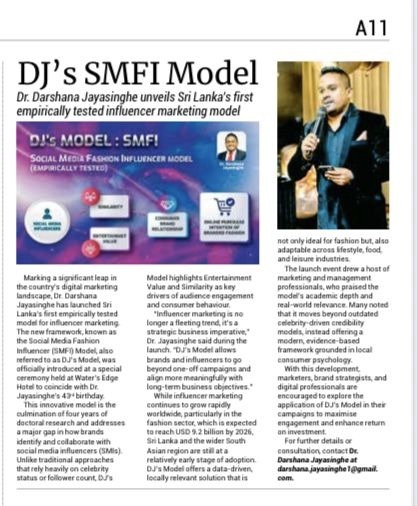
- Empirically tested Model
- First of its appearance to the Sri Lankan Market
Dr. Darshana Jayasinghe unveiled his first of its kind the influencer marketing model to the Sri Lankan social media market and influencer community at the special function held at the Water Edge Hotel recently to distinguished invitees at his 43rd birthday. After an extensive 4 years of empirical research work for his doctorate, he invented a contemporary influencer marketing model suits the Sri Lankan consumers. This signifies his commitment towards providing a solution to marketing & management professionals, and social media influencers to increase return on investment of their marketing spends and to provide key impetus to influencers to increase their engagement with social media users.
Social media influencer marketing is globally trending marketing tool, which is disrupting the conventional marketing communications. South Asian market it is still at the emerging stage, however, with increased consumption of TikTok and Instagram, Sri Lankan consumers are increasing engaging with the social media influencers (SMIs). SMIs are a unique set of third party social users who engage with their audience frequently to share, disseminate and convince their personal experiences. Often than not, SMI marketing is misinterpreted because SMIs are emerged from social media and not from the public domain or famous personalities like musicians, sport stars, Film stars, etc. These are ordinary social media users who have created their unique social media fan base and frequently engaged with personalized unique content.
In global fashion industry, 60% of brands use influencer marketing campaigns to increase sales. The global fashion influencer market is expected to reach US$ 9.2 billion by 2026, with a CAGR growth rate of 38.5%. Most of the research studies about SMIs have reviewed the efficacy and appealing nature of SMIs whilst other studies have focused on the conceptualisation of SMIs and content strategies. The literature to support the impact of SMIs on consumer-brand relationships (CBR) in driving brand trust, loyalty, and engagement is limited. There have been multiple empirical studies conducted on SMIs and their impact on business in general. However, there are limited empirical studies have been conducted in Sri Lanka on the impact of IM activities and their application on branded fashion products. Therefore, it is questionable whether investments in SMIs contribute to the business in terms of customer engagement and customer conversion.
Most often than not, SMIs are chosen more objectively based on numerical indicators such as follower base, engagement ratio, page rank, etc. for marketing or non-marketing campaigns. Management professionals have raised concerns over those numeric indicators as there have been instances where most of the followers have been found to be fake profiles and agency-aided used for improving their page ranks and the brands eventually ending up with less or no return on investment. Moreover, these types of vanity metrics are often soft selection indicators and do not provide a robust quality metrics. Many academic researchers tested the tri-source credibility model introduced by Ohanian in 1982 to evaluate the impact of celebrities in a different context. Thereby, most influencer marketing studies were evaluated based on conventional source-credibility model which is primarily for general celebrities who have built fame with a mass appeal in traditional media spaces and who are confined to a few individuals who are financially strong with sound justification.
This industry gap paved the way for a novel and contemporary model for SMIs introduced by Dr. Jayasinghe, where his doctoral study purely invested in to resolve this practice or industry gap. After an extensive 4-years quantitative research exploration, Dr. Jayasinghe introduced the DJ’s model with a new metrics to identify the SMIs for branded fashion products and that could be extended to other related lifestyle categories as well. The specialty of the DJ’s model is none of the source-credibility attributes link to SMIs and consumers engagement and purchasing intention. Two new attributes emerged strongly: Entertainment value & Similarity. Sri Lanka social users believe that they would consider those attributes when engage with SMIs and their ability persuade for purchase a product. DJ’s model does contribute to upcoming SMIs as the model facilitates SMIs to know about the key aspects they need to nurture to emerge as a SMI. Now, modern way of earning online is all about providing engaging content frequently and personalizing content to match to a similar audience.
DJ’s model was launched at the recently held event at the Waters Edge to an imminent marketing & management professional. The model is developed after a scrutinized empirical tested variables and using a scientific advanced statistical model by ending the extant research work globally. DJ’s model is now available for marketing & management professionals to consider and adopt their business and marketing campaigns. You can get more clarifications about the model, by reaching Dr. Jayasinghe through email: darshana.jayasinghe1@gmail.com. Dr. Jayasinghe highlighted that the SMI marketing should not be a tactical campaign or just a communication tool; it should be considered a strategic marketing communication instrument that would fit into the overall business strategy of the organization. This empirically validated model can be extended to other related categories like leisure, food, and lifestyle products, with some limitations to consider in application.