
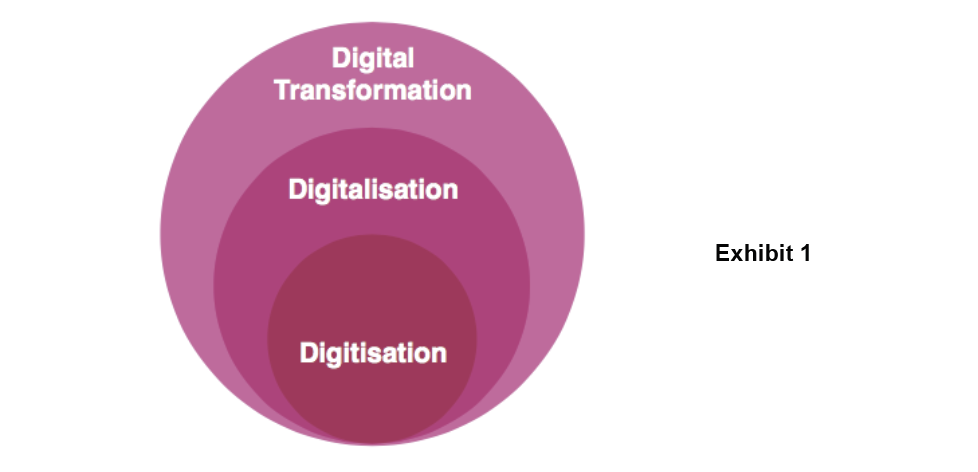
Sri Lanka began digital transformation in 1980s when personal computers started entering the offices and houses. It gathered pace after the introduction of mobile phones in 1989 and Internet services in 1995. Monopoly created in telecom sector opened up in mid 1990s and market was expanded thereafter with multiple operators. This has resulted mobile phones penetration rose over 100% in 2017 and it is currently at 150% in 2020. Moreover nearly half of the SL’s population connects to Internet with more than 6 million users active in social media. Even though we’ve seen significant changes in digital consumption, The World Economic Forum’s 2019 Network Readiness Index (NRI) ranked Sri Lanka at 83rd placed over 121 countries and 2017 SL’s was at 63rd position. This shows that SL has not moved ahead in technology transformation as a country in the last 2 years. Digital transformation is a long-term process. Digital transformation refers as the sum total of changes associated with the application of digital technologies in all aspects of society. Digitization has enabled the process of digitalization, which in turn has led to stronger opportunities to transform and change existing business models, socio-economic structures, legal and policy measures, organizational patterns and cultural barriers as shown below. (Exhibit 1) Digital transformation is not just being technology-centric, it is more than many would think. It requires change management in organisation as well as change management in all aspects of society. (Exhibit 2)
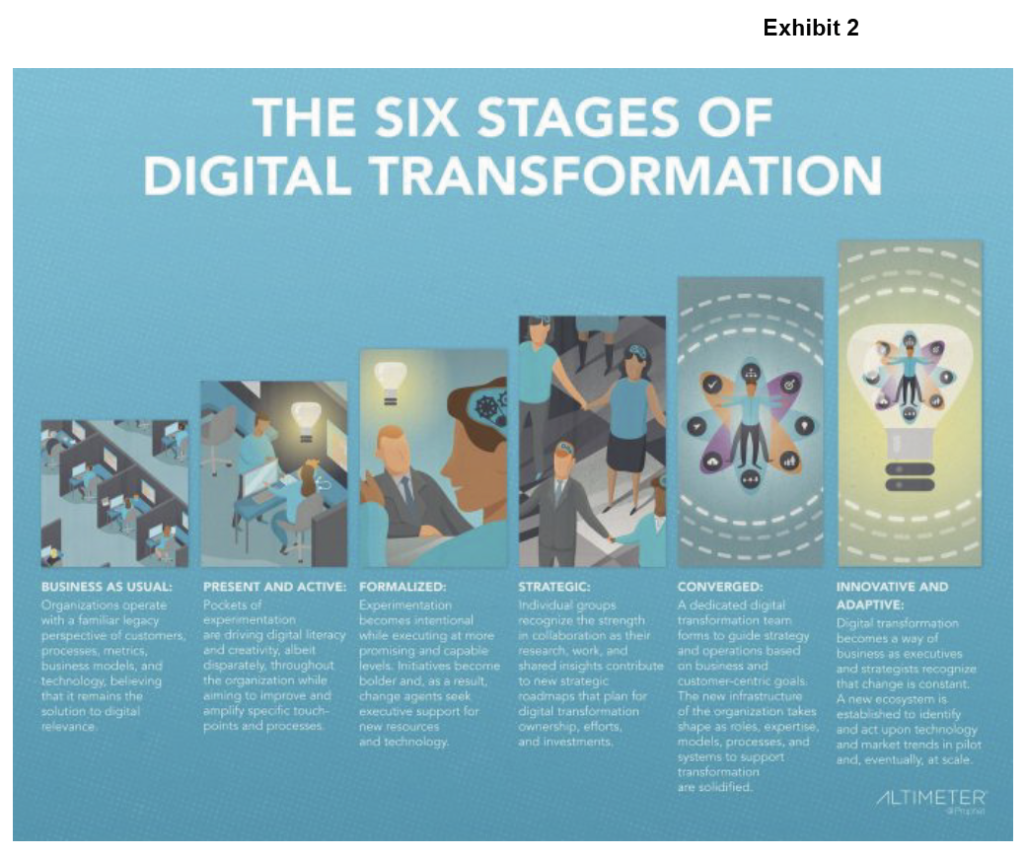
The recent McKinsey 2018 Digital Maturity report for SL highlighted that country’s digital maturity score or DQ score is at 35, which is slightly higher than global median score of 33. Further, in comparison with other Asia Pacific emerging markets Sri Lanka exhibits strengths in connectivity, digital marketing, investment in digital initiatives, and the ability to move quickly. Yet when compared with China, India, and more- developed countries, Sri Lanka is well behind. Its companies lag in appetite for risk, ability to integrate their digital priorities into the overall business strategy, automation of internal and customer-facing processes, and adoption of a collaborative culture between the digital teams and business functions Exhibit 3) Exhibit 2 Out of the companies taken for the study reveled that one in five companies are digital laggards and 60% of the companies are digital followers who are in the range of DQ score of 25-50. When 60% of the companies are using technology why can’t they reach the higher digital maturity score? It poses us a question then there are other reasons that enable the transformation from digitalized company to digital transformed company. The research found that companies with higher digital maturity (a high DQ score)
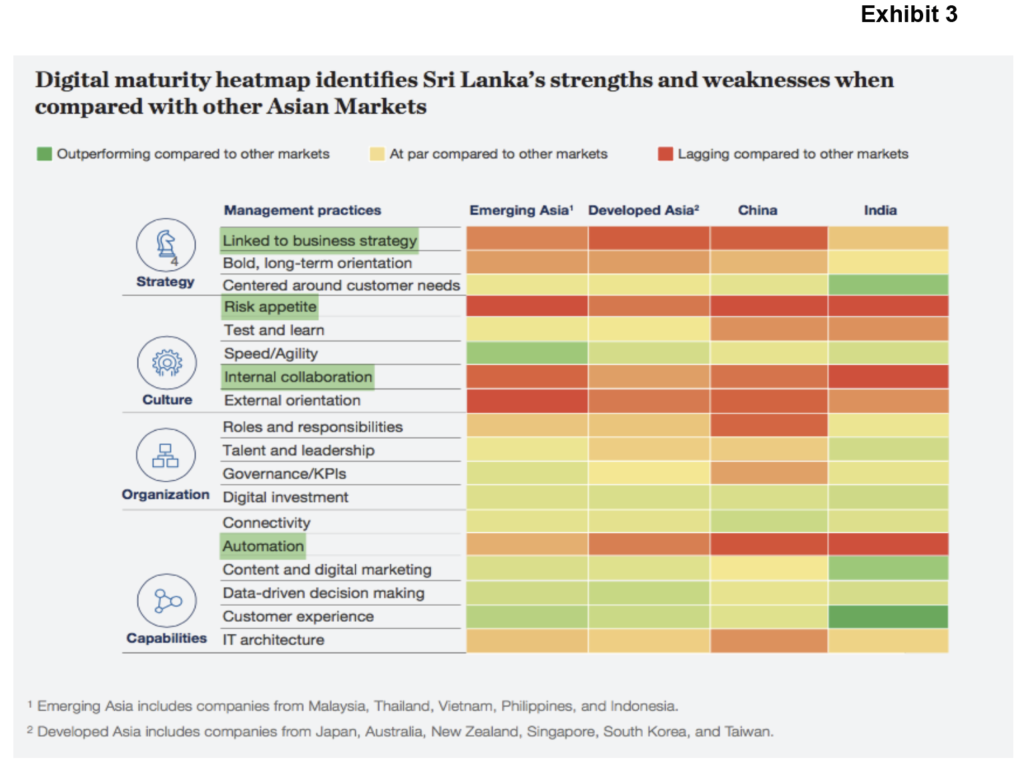
outperform the market, delivering two to five times more revenue growth than their peers over a five-year period.
Key Enablers of Successful Digital Transformation
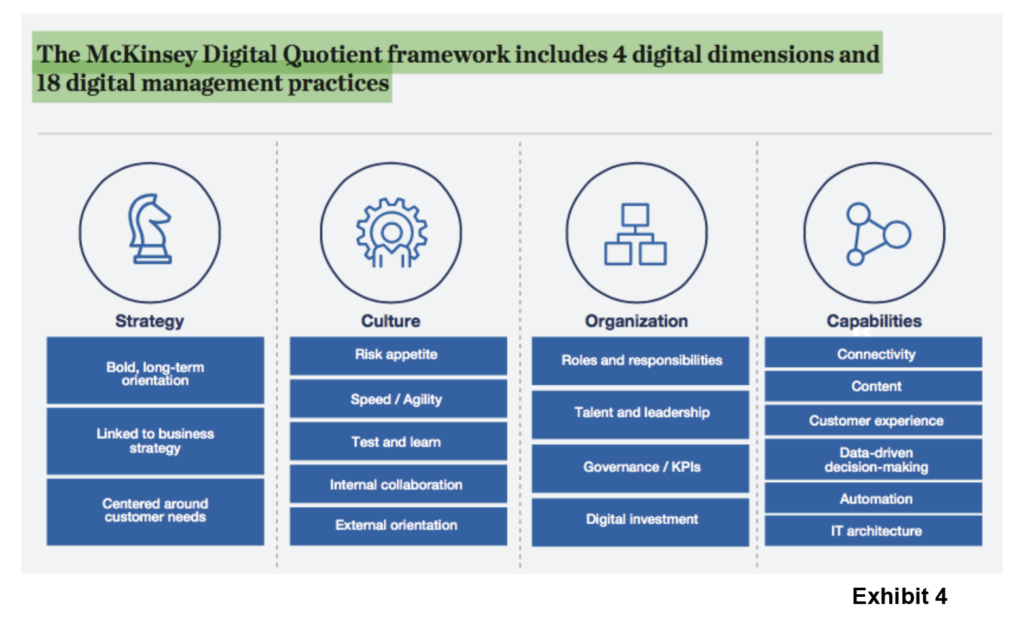
To discuss the enablers I use the McKinsey’s Digital Quotient framework that includes 4 digital dimensions and 18 digital management practices. (Exhibit 4)
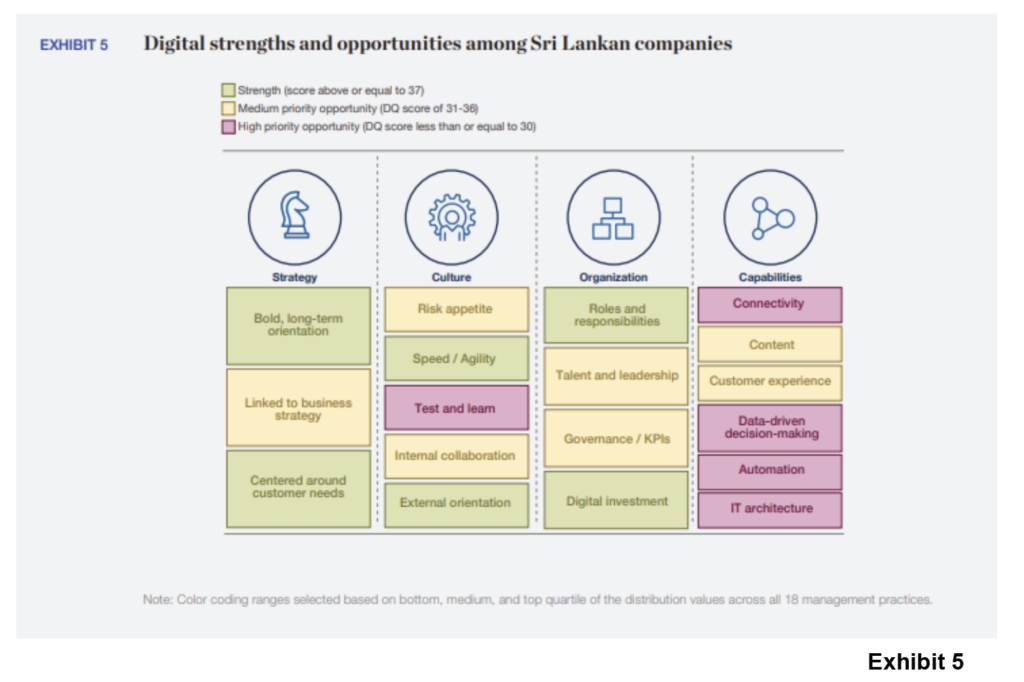
Based on the DQ framework, SL companies were evaluated on all 18 attributes and summary of key digital strengths and opportunities are given in the below diagram. (Exhibit 5)
1. Strategy
Most of SL’s businesses fail due to lack of strategic alignment. As per McKinsey’s study 90% of companies indicated that their digital initiatives are addressed to limited sub set of opportunities. Banking sector in Sri Lanka going through a digital transformation. Leading banks in SL are bringing cutting-edge technology without properly aligning to the company’s long terms plans. Also study indicated that only 30% of SL companies say that that digital strategy is driven by customers’ needs. This could be resulted due to competitors’ activities or due to psychological choice of top management. As shown in exhibit 3 SL companies need to address the strategy alignment in order to ladder up in the digital maturity index. It is imperative to get the management team rallies round the digitalization agenda and
navigating organisations to reach the desired state.
2. Culture
Study revealed that most SL companies’ culture is well suited and agile with the digital transformation. Traditional liner structures do not support transformation. More towards flat, agile and matrix structure with empowered responsibilities. It is also revealed that relative absence of test-and-learn practices is limiting the company’s ability to innovate and taking risk appetite. Therefore culture should promote innovations and no offense for failures. This would encourage teams to work across boundaries and work gets done collaboratively. Most IT companies in SL work with small teams, open office environment, flexi hours and promote work from home (WFH). This culture would enable employees to be more creative and agile in their working. Even start-up companies in SL work with agile culture that enables them to bring out minimum viable products (MVP).
3. Organisation
It is important that organisations define who are driving the digital transformation? What responsibilities assigned? What are key resources required? Buy-in from the top management and tone at the top, how do we measure the evolvement of digital? and investments for the IT infrastructure and development. As per the McKinsey report SL companies need to get right digital talent, leadership involvement and proper governance structure to measure the progress is key to fast track digital transformation. Some organisations opt to have a separate business unit for digital transformation where its core business is intact and no interruption. Some may embark on full-scale digital transformation or its existing business model. Just as important as recruiting and developing talent is reducing the risk of losing them. Global study indicated that 80% of respondents want t work for digital enabled company or digital leader. Also it is important t reskill existing employees to support the digital agenda. Continuou training and development, automation and improving digital literacy will help organisations to have an agile workforce. You have to be an influential leader in the physical, virtual and augmented worlds,” says Disney senior vice president Milovic. Getting the involvement and sponsorship for digital transformation from C-Suite influential leader is critical for the journey. Also KPIs should be determined at the outset and need to be communicated for employees. KPIs should ideally be quantitative and need to be linked for individual’s performance objectives.
4. Capabilities
Study shows that this category needs more emphasis as most of attributes have high degree of opportunity for improvement. Connectivity, data driven decision-making, Automation and IT architecture are the areas need improvement for SL companies. Most organisations in Sri Lanka do backward integration, but they failed to look at forward integration. This would help to increase customer experience and convenient personalized offering. Most financial institutions in SL do backward integrations however they do not look at the forward integrations as much serious as backward integration.
Study also revealed that less than 20% of SL companies have robust analytical methods and less than 10% companies claimed that they anlayse data to generate insights and improve performance. Business intelligent unit should gather data, analyse and provide predicative analytics to support decision-making. Most banks, Telcom and FMCG companies will have high potential to drive big data analytics. Some companies have Business Intelligence (BI) units but they do not provide proactive data analytics to support decision-making. Sri Lankan companies can substantially improve their customer-satisfaction scores by making operational enhancements, primarily by accelerating and simplifying their interactions with customers using data analytics and machine learning. It was revealed that more than 85% of SL companies struggle to use digital technologies to enable automation. Fear to make full automation is another reason. This is mainly due to fear of using core business and lack
of confidence on new systems. E-commerce businesses are struggling to integrate logistics and payments options due to regulatory concerns. Shifts from legacy IT systems to more open interoperable platforms such as cloud computing, Blockchain, APIs etc. will accelerate the digital transformation journey. Very few companies in Sri Lanka use above open network platforms. To conclude digital transformation is neither a simple process nor short journey. It requires top management commitment and requires right escalation to the floor level by properly communicating company’s aspirations. It requires agile and flexible culture that fosters fearless entrepreneurial mindset that drives innovation. Invest in right talent and grooming them during the transformation period is crucial for speed adaptation. Investing on cutting-edge IT platforms, business intelligence and increasing customer’s value proposition and experience through Omni channel marketing would make SL companies truly a digital transformed companies.